
Affirming Your Quiet Superpowers
Category:Introverted Leadership,Leadership,PodcastAffirming your Quiet Superpowers: Build on Strengths, Not Weaknesses
Early in my career, I had a very specific picture in my mind of what a leader “should” look like.
I assumed leadership belonged to the most vocal, highly visible people in the room. Because that wasn’t me, I spent years wondering if my quiet nature was a career handicap. I know now that I wasn’t the only one struggling with that assumption.
In a classic episode of my Hope for the Introvert podcast, I spoke with Melanie Seibert (who is today the UX Content Design Manager on the Web Team at PayPal). She confessed that early in her career, she spent a lot of time wishing she had a different set of personality traits. It took a conscious, deliberate shift for her to accept the strengths she actually possesses—like deep analysis and creativity—and learn how to leverage them, rather than trying to force a persona.
In corporate and academic spaces, we are often conditioned to obsess over our weaknesses. We get annual reviews pointing out our “areas of growth” and spend valuable energy trying to patch up deficits.
Melanie shared a philosophy from her time at Rackspace that completely flips this on its head:
“You will go much farther building on your natural strengths than you will trying to mitigate your weaknesses.”
When you stop trying to force yourself into an extroverted mold, a few powerful shifts begin to happen—both internally and externally.
The Internal Shift: Redefining Leadership
Realizing you don’t need to be loud to lead is a liberating moment. When you embrace strength-based growth over weakness repair, your perspective on leadership changes:
-
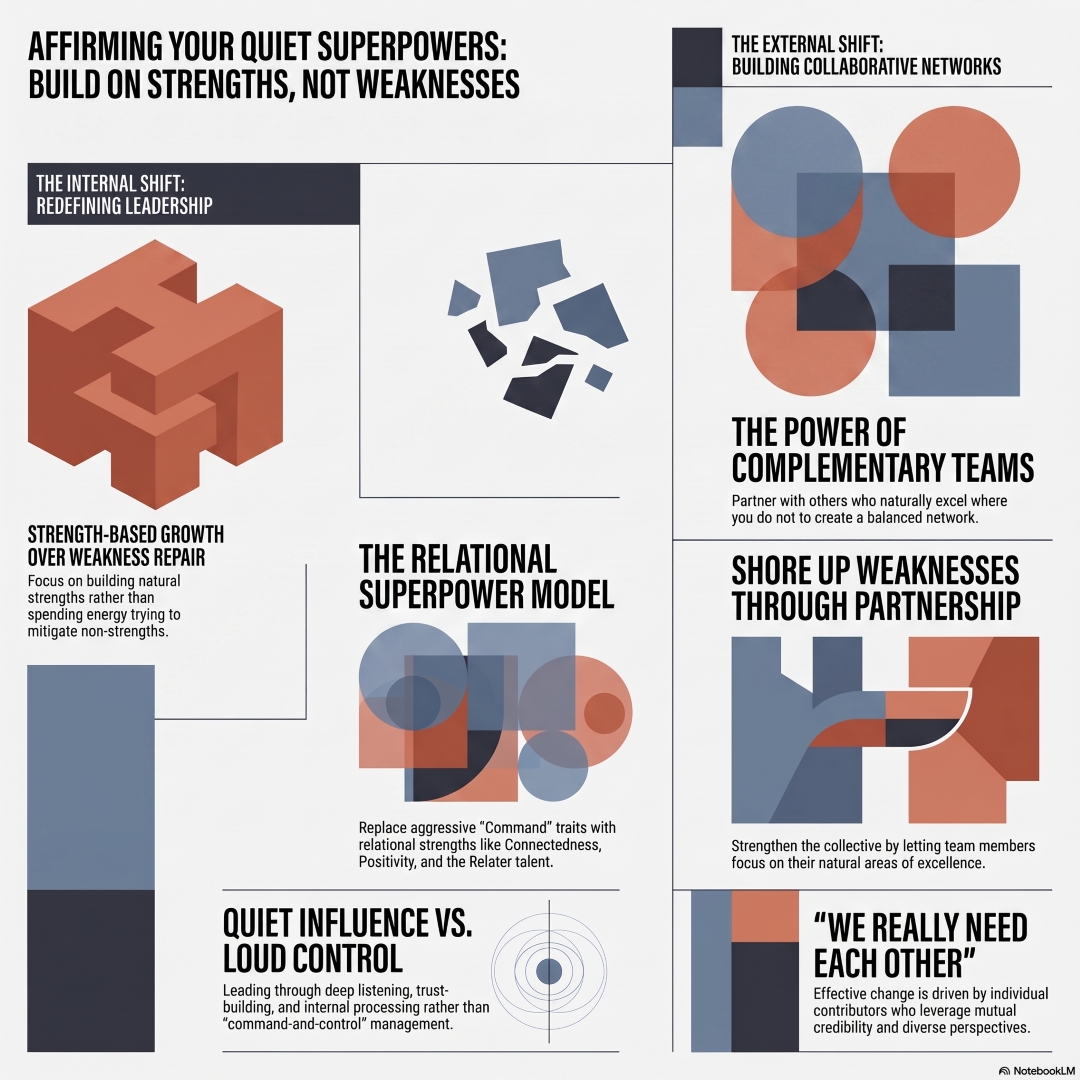
Quiet Influence vs. Loud Control: Leadership isn’t about command-and-control management. It’s about leading through deep listening, trust-building, and thoughtful internal processing.
-
No Formal Title Required: A massive amount of organizational change is driven by individual contributors who build lateral credibility and trust among their peers. You don’t need formal authority to make an impact.
-
No Single Template: You can lead effectively while being quiet, analytical, and deeply reflective.
-
Context Matters: If you are in an environment where quiet leadership isn’t valued, it doesn’t mean you aren’t a leader—it might just mean you are in the wrong place.
The External Shift: Building Collaborative Networks
Focusing on your natural abilities doesn’t mean ignoring your blind spots. Instead of trying to fix every non-strength yourself, the goal is to build a Relational Superpower Model:
-
The Power of Complementary Teams: If you aren’t naturally suited for a specific task, find a teammate who is, and collaborate. Shore up your weaknesses through partnership rather than solo struggle.
-
“We Really Need Each Other”: True team strength comes from allowing each member to focus on their natural areas of excellence. We don’t need a team of identical leaders; we need complementary teams that bring diverse perspectives to the table.
Turning Your Handicap Into an Asset
Helping quiet professionals recognize their natural strengths—and turn what they thought was a career handicap into quiet superpowers—is the most rewarding part of my work.
That’s why I facilitate the EDUCAUSE Learning Lab: Quiet Leadership: Strategies for Influence and Impact. In this interactive experience, we use temperament and strength inventories as a practical foundation to help you identify your innate abilities, navigate organizational challenges, and design a personalized 12-month action plan.
➡️ Interested in joining the next cohort? You can check upcoming dates and register for the Learning Lab here. (Open to both EDUCAUSE members and non-members).
Affirming Your Quiet Superpowers: Build on Strengths, Not Weaknesses Infographic