
Tag Archives: Quiet Leadership

  • 0

The Introvert’s Dilemma: Why We Fight for Our Teams but Hide from Ourselves

Category:Career Development,Introverted Leadership,Podcast Tags : 

The Introvert’s Dilemma: Why We Fight for Our Teams but Hide from Ourselves

“I have no problem going to battle for my team under any circumstance. But if you ask me to do the same thing for myself, I’ll go hide in a corner.”

When Eeshita Grover said those words to me during a podcast interview a few years back, I didn’t just laugh—I felt them. It hits incredibly close to home for so many of us.

Advocating for our teams comes naturally. When it comes to protecting our teams, advocacy comes naturally to us. But when the focus shifts to self-promotion, navigating office politics, or managing up in a massive organization, we often pull back.
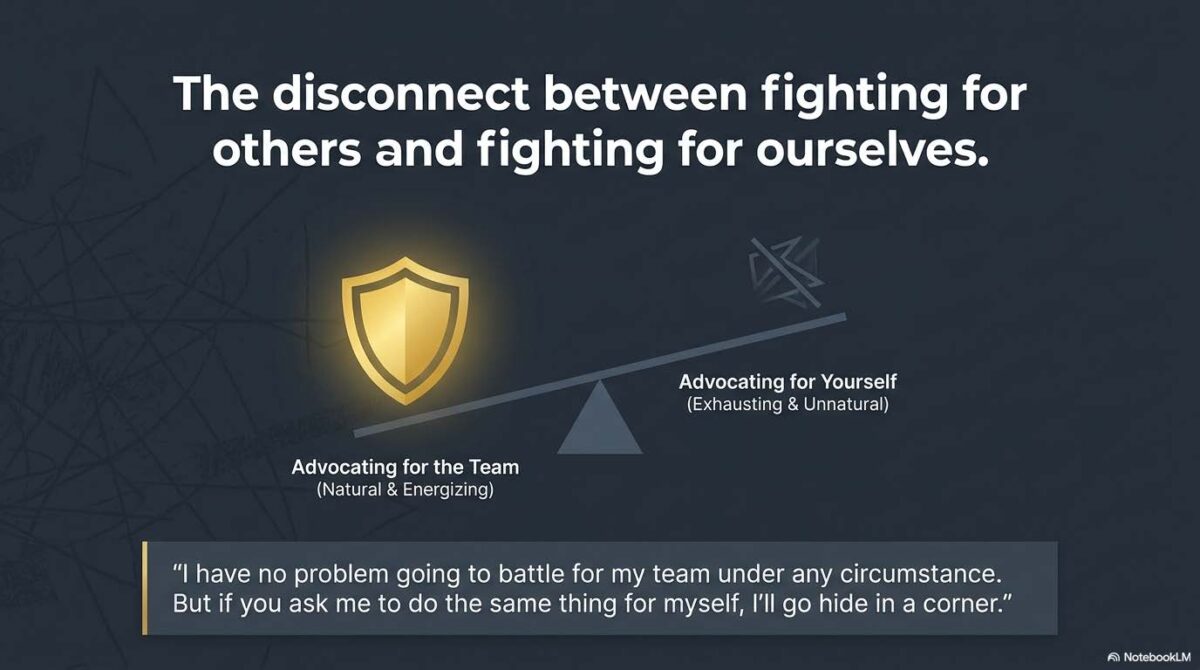
Slide titled "The disconnect between fighting for others and fighting for ourselves." A seesaw graphic contrasts "Advocating for the Team (Natural & Energizing)" weighted down by a glowing gold shield, against "Advocating for Yourself (Exhausting & Unnatural)". Below reads a quote: "I have no problem going to battle for my team under any circumstance. But if you ask me to do the same thing for myself, I'll go hide in a corner."

The Challenges of Managing Up and Self-Promotion for Introverts

As introverts, we constantly face the underlying pressure to be someone else just to be heard. We’re told to “speak up,” to “command the room,” or to master the art of the humblebrag. But trying to fake a loud, outgoing persona is not only exhausting; it’s unsustainable.

Today, Eeshita is the Senior Director of Cisco Validated Designs. Throughout her upward career trajectory at Cisco—including her years leading marketing teams—she has built a remarkably successful leadership path not by changing who she is, but by leaning heavily into her quiet strengths.

During our conversations on the Hope for the Introvert podcast, she shared how she tackles managing up and building lateral influence without the stress of pretending to be an extrovert. Her approach comes down to three fundamental shifts in mindset and strategy.

1. Shift from Self-Promotion to Education

Most introverts loathe self-promotion because it feels deeply unnatural, arrogant, or performative. The trick is to take the ego out of it completely. Instead of thinking, “How do I show off what I did?” frame it as an act of service: “How do I keep people informed?”

When you proactively share what your team is working on, the obstacles you’re solving, and the value being delivered, you aren’t bragging. You are educating your peers and management chain. You’re providing data that helps them do their jobs better.
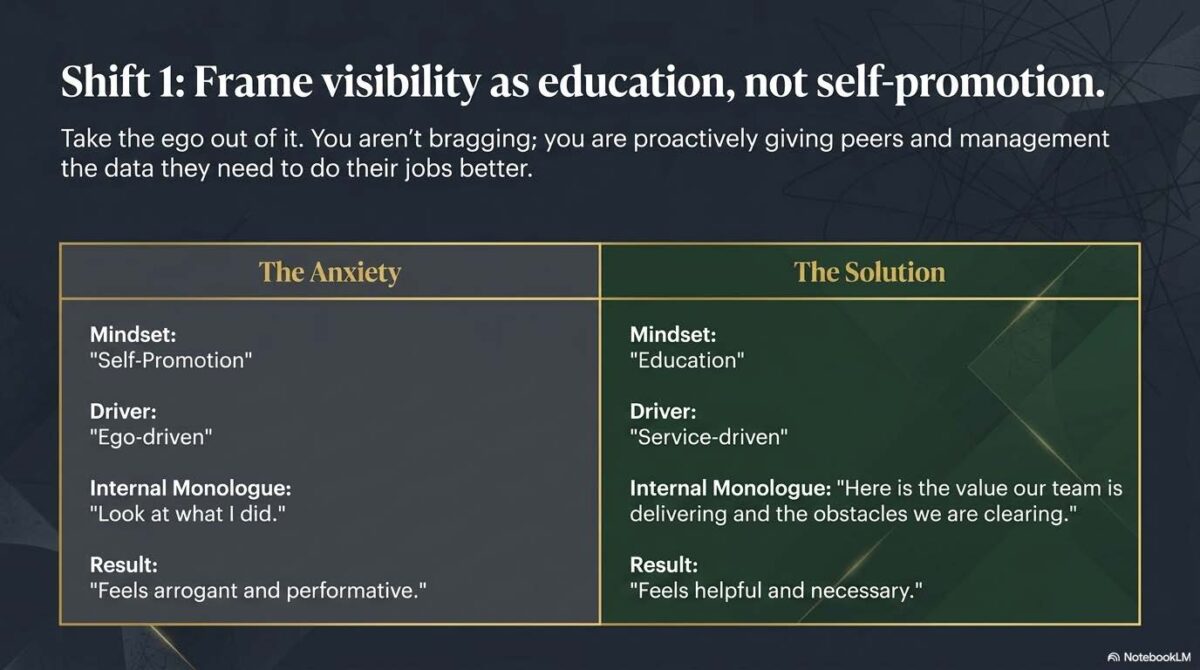
Slide titled "Shift 1: Frame visibility as education, not self-promotion." A comparative table contrasts "The Anxiety" against "The Solution." The anxiety column describes an ego-driven mindset focused on self-promotion that feels arrogant. The solution column describes a service-driven mindset focused on education that feels helpful and necessary by sharing team value and obstacles.

2. Rely on the One-on-Ones for Managing Up

You do not need to dominate a 50-person boardroom to have a massive impact on an organization. In fact, real organizational alignment rarely happens in those big meetings anyway; it happens in the margins.

Eeshita’s primary tool for building influence is the quiet, intentional relationship. A brief, 30-minute individual chat or a casual coffee allows you to connect deeply, listen intently, and build high-trust alliances. Lateral influence is built brick by brick, one quiet conversation at a time.
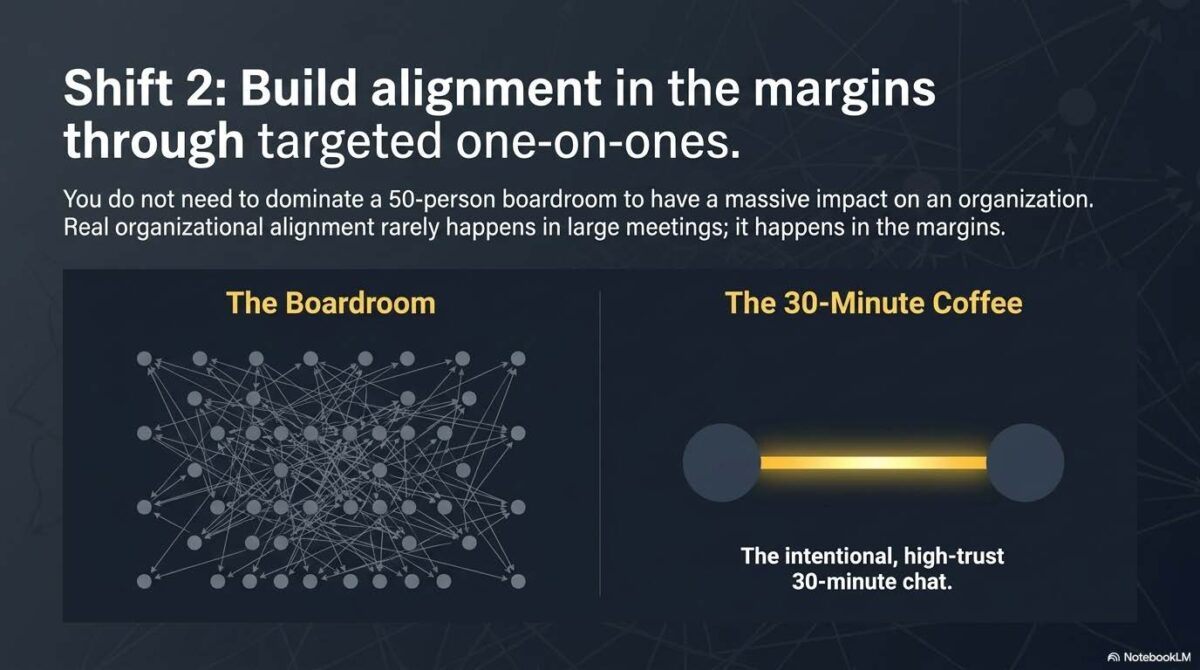
Slide titled "Shift 2: Build alignment in the margins through targeted one-on-ones." Below, a visual graphic compares "The Boardroom"—a chaotic, webbed network of complex node connections—against "The 30-Minute Coffee," represented simply by two nodes joined by a glowing yellow line labeled "The intentional, high-trust 30-minute chat."

3. Claim the 48-Hour Advantage for Quiet Leadership

Eeshita used a phrase that stuck with me: “Quiet people have the loudest minds.”

Because introverts are analytical observers, we absorb an incredible amount of detail, subtext, and dynamics during a meeting. The corporate world often rewards the person who speaks first, but immediate verbal processing isn’t our superpower. Our best, most comprehensive insights usually surface about 48 hours after the dust has settled.

Don’t feel pressured to have the definitive answer on the spot. Own your timeline. Sending a thoughtful, deeply considered follow-up email two days later with the exact solution everyone missed is incredibly powerful—and it is always worth the wait.
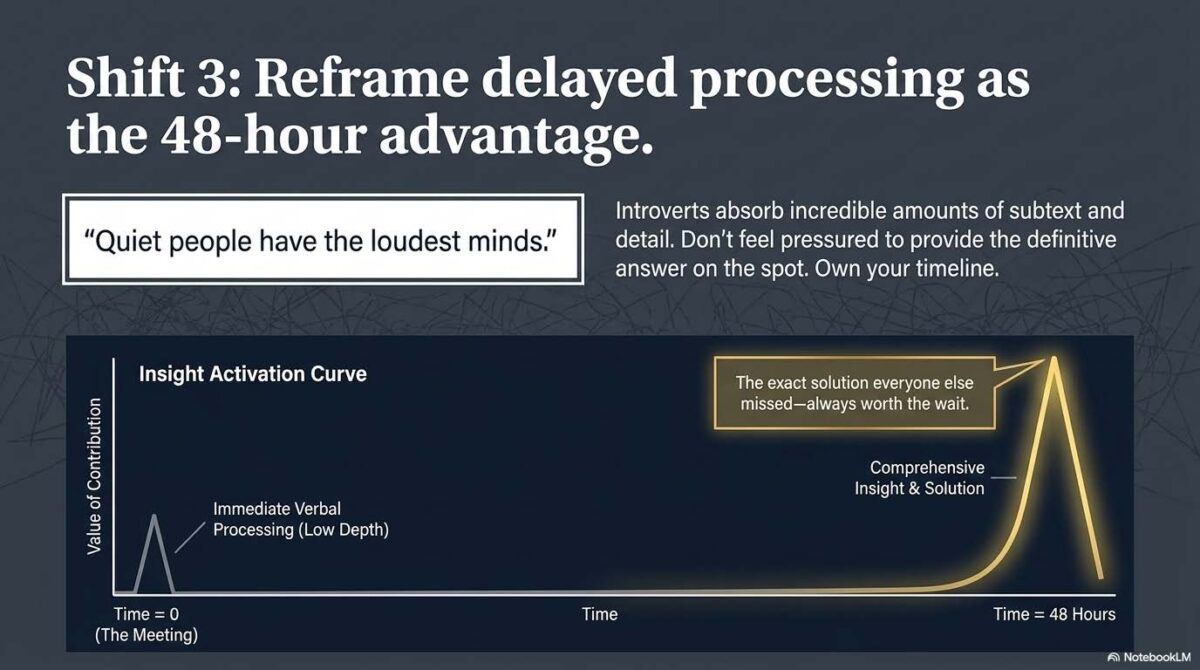
Slide titled "Shift 3: Reframe delayed processing as the 48-hour advantage." Features the quote "Quiet people have the loudest minds." A graph titled "Insight Activation Curve" illustrates the value of contribution over time, showing a small spike at Time = 0 (The Meeting) for immediate verbal processing, followed by a much higher peak at Time = 48 Hours for comprehensive insights and solutions.

Leading Authentically Without Faking an Outgoing Persona

We don’t need to become the loudest voices in the room to lead. True leadership isn’t about volume; it’s about depth, reflection, and empathy.

Master Managing Up at the EDUCAUSE Learning Lab

This is exactly what we focus on during our EDUCAUSE Learning Lab: Quiet Leadership: Strategies for Influence and Impact. This online, synchronous lab is designed as a practical space to help you map out your own strategies for communicating value, building networks of trust, and managing up with quiet confidence.

(Note: While we tailor the context to the higher ed and IT landscape, the lab is open to anyone looking to lead authentically—you do not need an EDUCAUSE membership to join).

You can find the links to register for the Learning Lab and listen to my full podcast episodes with Eeshita below.


  • 0
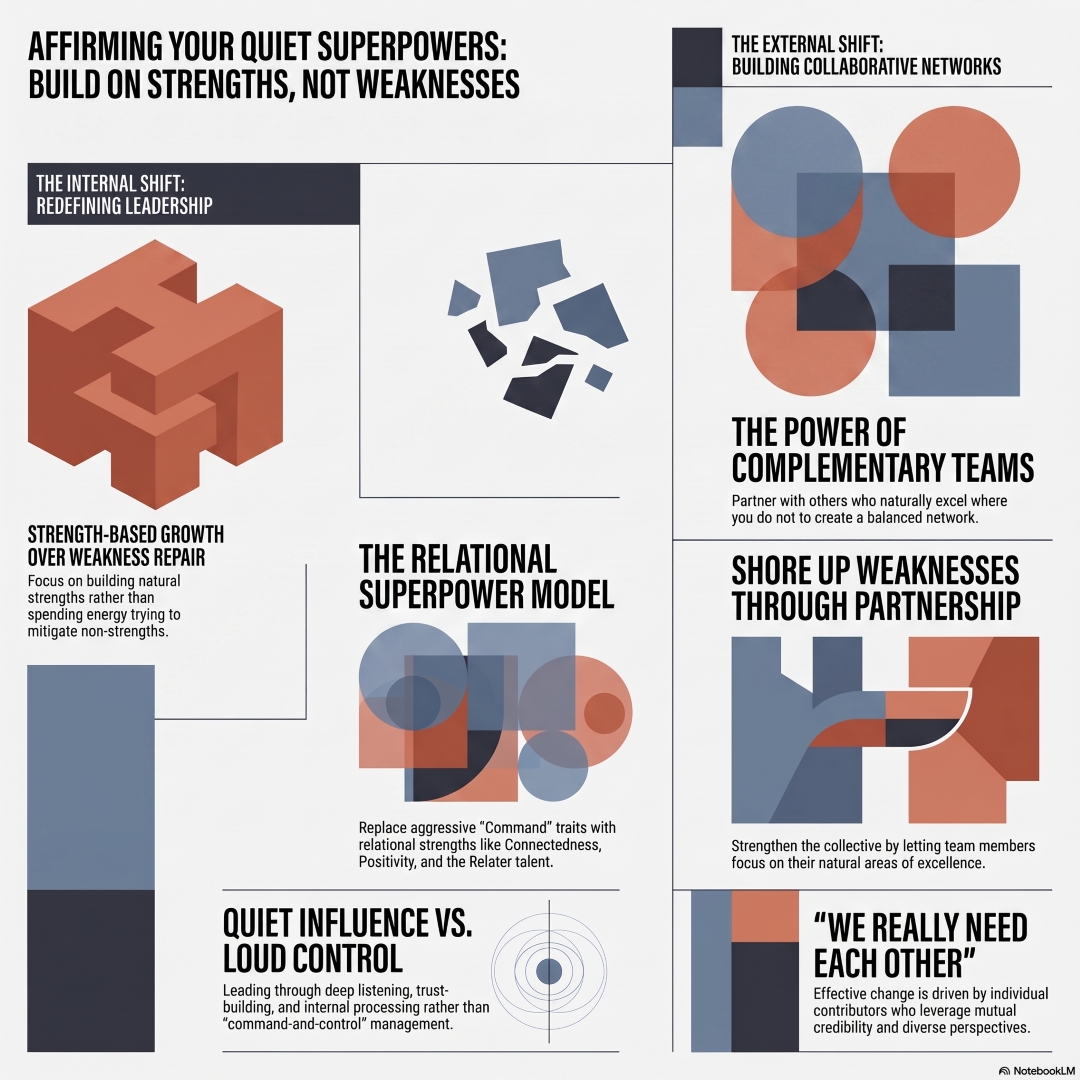
Infographic titled "Affirming Your Quiet Superpowers: Build on Strengths, Not Weaknesses," featuring two main sections detailing internal and external shifts for quiet leadership: The Internal Shift: Redefining Leadership Strength-Based Growth Over Weakness Repair: Focuses on building natural strengths rather than spending energy trying to mitigate non-strengths. Quiet Influence vs. Loud Control: Focuses on leading through deep listening, trust-building, and internal processing rather than "command-and-control" management. The Relational Superpower Model: Replaces aggressive "Command" traits with relational strengths like Connectedness, Positivity, and the Relater talent. The External Shift: Building Collaborative Networks The Power of Complementary Teams: Partners with others who naturally excel where you do not to create a balanced network. Shore Up Weaknesses Through Partnership: Strengthens the collective by letting team members focus on their natural areas of excellence. "We Really Need Each Other": Highlights that effective change is driven by individual contributors who leverage mutual credibility and diverse perspectives.

Affirming Your Quiet Superpowers

Category:Introverted Leadership,Leadership,Podcast Tags : 

Affirming your Quiet Superpowers: Build on Strengths, Not Weaknesses

Early in my career, I had a very specific picture in my mind of what a leader “should” look like.

I assumed leadership belonged to the most vocal, highly visible people in the room. Because that wasn’t me, I spent years wondering if my quiet nature was a career handicap. I know now that I wasn’t the only one struggling with that assumption.

In a classic episode of my Hope for the Introvert podcast, I spoke with Melanie Seibert (who is today the UX Content Design Manager on the Web Team at PayPal). She confessed that early in her career, she spent a lot of time wishing she had a different set of personality traits. It took a conscious, deliberate shift for her to accept the strengths she actually possesses—like deep analysis and creativity—and learn how to leverage them, rather than trying to force a persona.

In corporate and academic spaces, we are often conditioned to obsess over our weaknesses. We get annual reviews pointing out our “areas of growth” and spend valuable energy trying to patch up deficits.

Melanie shared a philosophy from her time at Rackspace that completely flips this on its head:

“You will go much farther building on your natural strengths than you will trying to mitigate your weaknesses.”

When you stop trying to force yourself into an extroverted mold, a few powerful shifts begin to happen—both internally and externally.

The Internal Shift: Redefining Leadership

Realizing you don’t need to be loud to lead is a liberating moment. When you embrace strength-based growth over weakness repair, your perspective on leadership changes:

  • Quiet Influence vs. Loud Control: Leadership isn’t about command-and-control management. It’s about leading through deep listening, trust-building, and thoughtful internal processing.

  • No Formal Title Required: A massive amount of organizational change is driven by individual contributors who build lateral credibility and trust among their peers. You don’t need formal authority to make an impact.

  • No Single Template: You can lead effectively while being quiet, analytical, and deeply reflective.

  • Context Matters: If you are in an environment where quiet leadership isn’t valued, it doesn’t mean you aren’t a leader—it might just mean you are in the wrong place.

The External Shift: Building Collaborative Networks

Focusing on your natural abilities doesn’t mean ignoring your blind spots. Instead of trying to fix every non-strength yourself, the goal is to build a Relational Superpower Model:

  • The Power of Complementary Teams: If you aren’t naturally suited for a specific task, find a teammate who is, and collaborate. Shore up your weaknesses through partnership rather than solo struggle.

  • “We Really Need Each Other”: True team strength comes from allowing each member to focus on their natural areas of excellence. We don’t need a team of identical leaders; we need complementary teams that bring diverse perspectives to the table.

Turning Your Handicap Into an Asset

Helping quiet professionals recognize their natural strengths—and turn what they thought was a career handicap into quiet superpowers—is the most rewarding part of my work.

That’s why I facilitate the EDUCAUSE Learning Lab: Quiet Leadership: Strategies for Influence and Impact. In this interactive experience, we use temperament and strength inventories as a practical foundation to help you identify your innate abilities, navigate organizational challenges, and design a personalized 12-month action plan.

➡️ Interested in joining the next cohort? You can check upcoming dates and register for the Learning Lab here. (Open to both EDUCAUSE members and non-members).

Infographic titled "Affirming Your Quiet Superpowers: Build on Strengths, Not Weaknesses," featuring two main sections detailing internal and external shifts for quiet leadership:  The Internal Shift: Redefining Leadership  Strength-Based Growth Over Weakness Repair: Focuses on building natural strengths rather than spending energy trying to mitigate non-strengths.  Quiet Influence vs. Loud Control: Focuses on leading through deep listening, trust-building, and internal processing rather than "command-and-control" management.  The Relational Superpower Model: Replaces aggressive "Command" traits with relational strengths like Connectedness, Positivity, and the Relater talent.  The External Shift: Building Collaborative Networks  The Power of Complementary Teams: Partners with others who naturally excel where you do not to create a balanced network.  Shore Up Weaknesses Through Partnership: Strengthens the collective by letting team members focus on their natural areas of excellence.  "We Really Need Each Other": Highlights that effective change is driven by individual contributors who leverage mutual credibility and diverse perspectives.

Affirming Your Quiet Superpowers: Build on Strengths, Not Weaknesses Infographic


  • 0
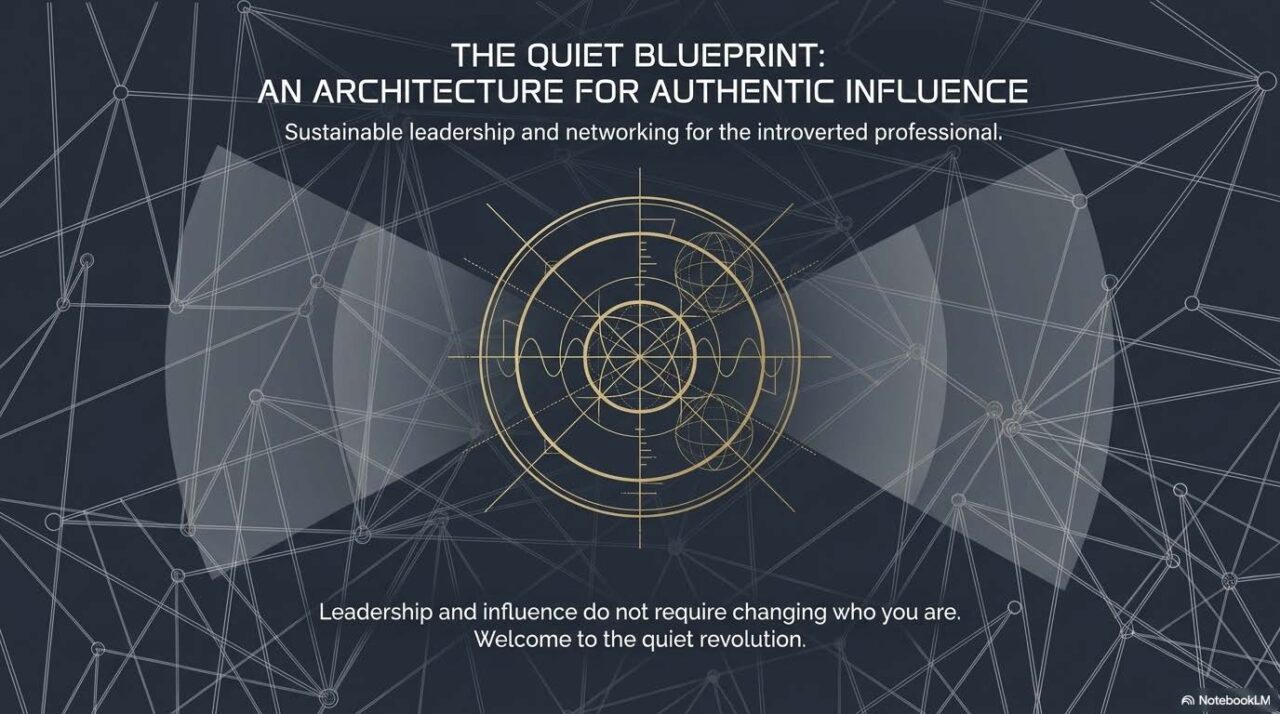
Image of geometric shapes with title: The Quiet Blueprint: An Architecture for Authentic Influence

The Quiet Blueprint: A Strategic Networking Guide for Introverted Leaders

Category:EDUCAUSE,introversion,Introverted Leadership,introverts,Leadership,Lessons Learned,Podcast,Social Networking,Social Networks Tags : 

When we think about professional networking, we usually picture crowded conference halls and making painful small talk over a stack of business cards. But for many of us in higher ed and IT, that isn’t our daily reality anymore. Our teams, stakeholders, and peers are often highly distributed—spread across different campuses, departments, or working completely remotely.

A past guest on my podcast, Andrea Childress (now CIO and Assistant Vice President for ITS at the University of Nebraska at Kearney), talked about what it was like when her university’s IT organizations combined, leaving her managing teams spread across multiple cities. She admitted that initiating relationships purely for the sake of it is a real challenge in that environment.

But she also reminded me of a fundamental truth: “I can’t overestimate how valuable it is to have a network, to lean on that network, [and] to provide support to that network.”

So how do we do that without the sheer exhaustion of “virtual schmoozing”?

I’ve mapped out a framework I call The Quiet Blueprint: An Architecture for Authentic Influence. It’s a sustainable way for introverted professionals to build real, lasting connections. Here is how we can shift the paradigm.

A dark blue blueprint-style title slide with a gold and white diagram of two circles connected by a glowing line, surrounded by concentric wave lines. Text reads: "The Quiet Blueprint: An Architecture for Authentic Influence. Sustainable leadership and networking for the introverted professional."

Redefining Networking: Depth Over Breadth

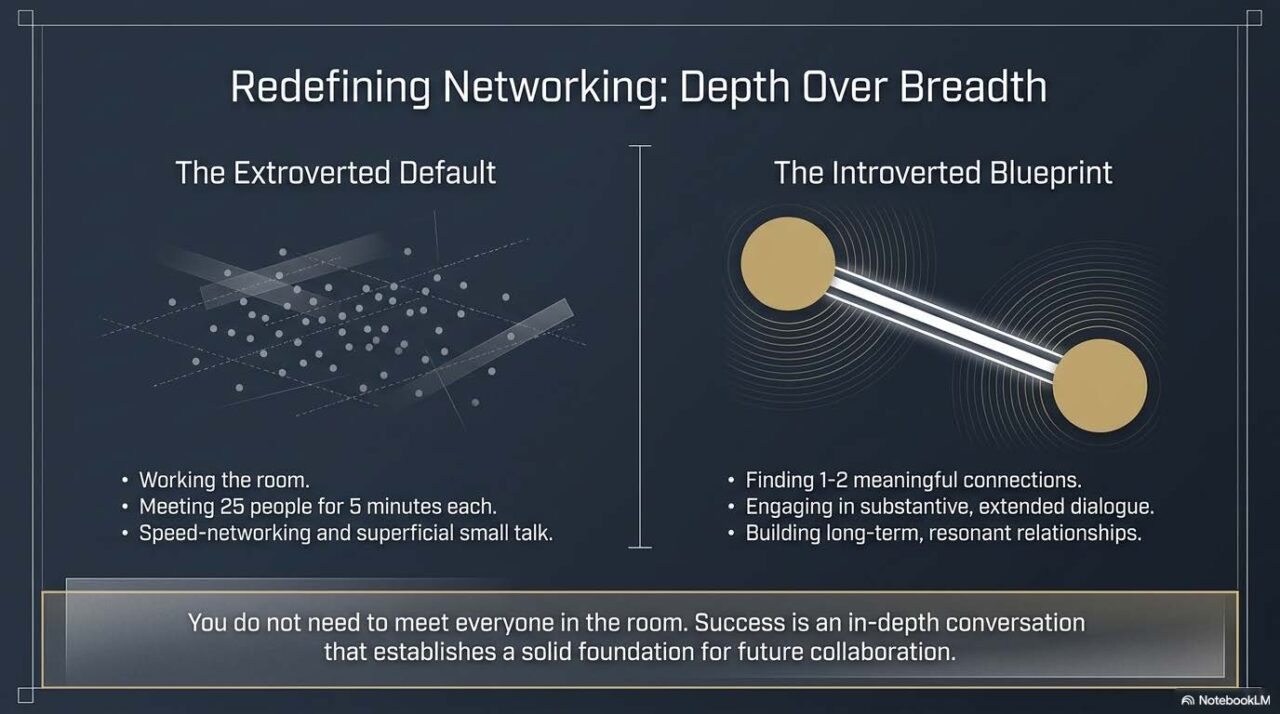
The traditional, extroverted approach to networking is all about “working the room”—meeting 25 people for 5 minutes each. For introverts, that’s a quick recipe for superficial small talk and immediate burnout.

We need to flip that metric. Success isn’t about how many hands you shake; it’s about finding one or two meaningful connections and having a real, extended conversation. You don’t need to meet everyone in the room to build a solid foundation for future collaboration.

A slide titled "Redefining Networking: Depth Over Breadth" with a graphic of a central circuit board and node paths. It compares "The Extroverted Default" (working the room, meeting 25 people for 5 minutes, superficial small talk) with "The Introverted Blueprint" (finding 1-2 meaningful connections, extended dialogue, and building long-term relationships).

Practical Coping: Two Anchors in the Moment

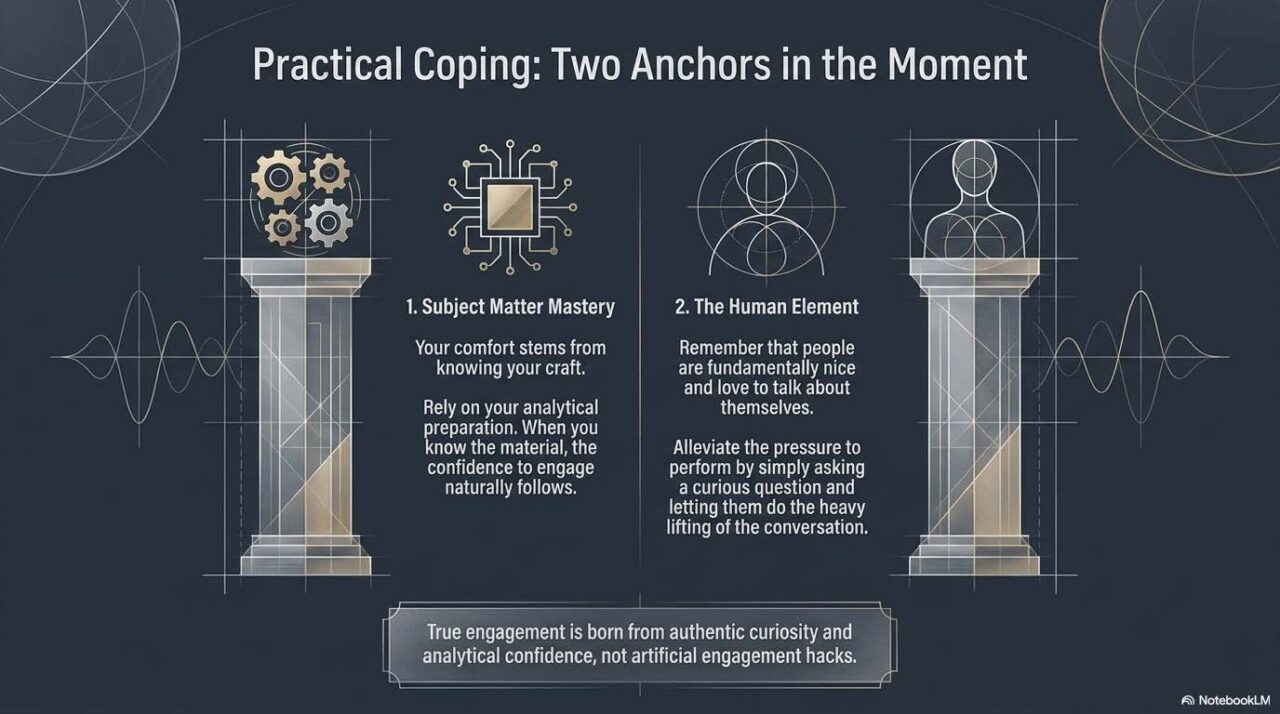
When you find yourself in a high-stakes networking environment, it’s easy to feel overwhelmed. I find it incredibly helpful to rely on two practical “anchors” to take the pressure off:

  • Subject Matter Mastery: Lean on your analytical preparation. When you truly know your craft, the confidence to engage naturally follows.

  • The Human Element: Remember that most people are fundamentally nice and, honestly, they love to talk about themselves. You don’t need to perform; just ask a curious question and let them do the heavy lifting.

A slide titled "Practical Coping: Two Anchors in the Moment" featuring architectural blueprints of classical pillars and soundwaves. It lists two anchors: "Subject Matter Mastery," relying on deep analytical preparation for natural confidence, and "The Human Element," alleviating pressure by asking curious questions because people love to talk about themselves.

The Energy Engine: Managing the Introvert Battery

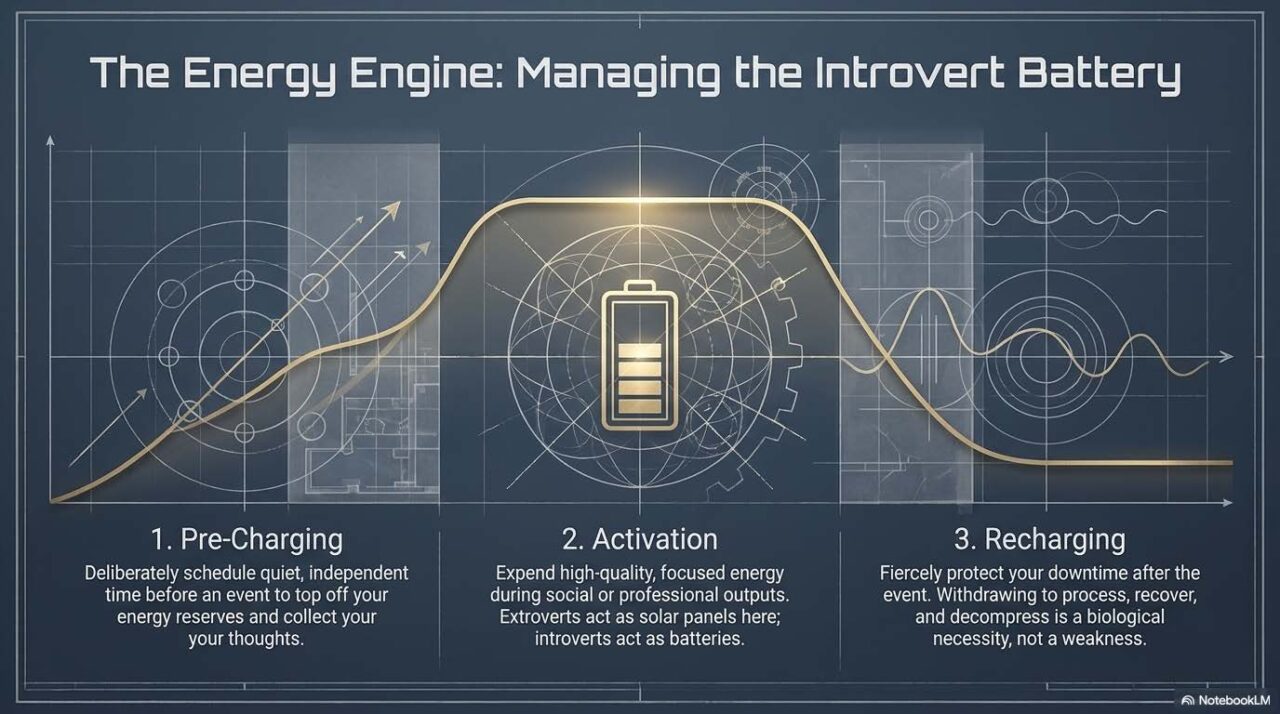
Extroverts are a bit like solar panels—they actually draw energy from busy social environments. Introverts, on the other hand, function like batteries. We expend high-quality, focused energy when we interact with others, and we have to be highly intentional about how we manage that charge.

To keep from running on empty, I look at energy management in three distinct phases:

  • Pre-Charging: Deliberately scheduling quiet, independent time before an event to top off your energy reserves and collect your thoughts.

  • Activation: Giving focused, authentic energy during the actual interaction.

  • Recharging: Fiercely protecting your downtime afterward. Slipping away to process, recover, and decompress isn’t a weakness—it’s a biological necessity.

A slide titled "The Energy Engine: Managing the Introvert Battery" showing a glowing battery icon overlaid on a circular blueprint schematic. It outlines three phases: "Pre-Charging" with scheduled quiet time before events, "Activation" by expending focused energy during interactions, and "Recharging" by fiercely protecting downtime afterward.

Cultivating a Cohort of Trust

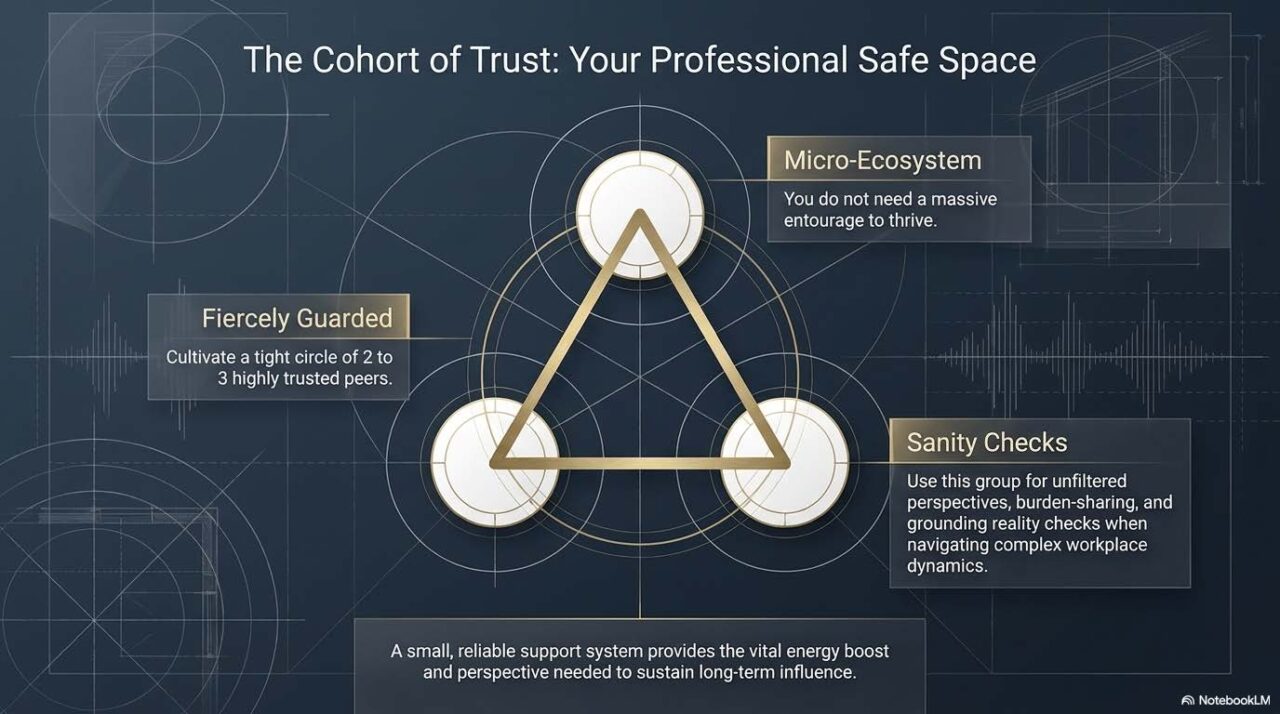
You don’t need a massive entourage or hundreds of superficial contacts to thrive in your career. True, sustainable influence is built within a small “micro-ecosystem”—a tight circle of just two to three highly trusted peers.

I encourage you to fiercely guard this inner circle. This is the group you go to for unfiltered perspectives, mutual support, and those vital “sanity checks” we all need when navigating complex workplace dynamics.

A slide titled "The Cohort of Trust: Your Professional Safe Space" featuring a gold triangle connecting three white circular nodes on a blueprint grid. It describes a "Micro-Ecosystem" of 2 to 3 fiercely guarded, highly trusted peers used for mutual support and reality checks to navigate complex workplace dynamics.

Reciprocal Mentoring: A Two-Way Street

I find that many of us in the quiet leadership community avoid traditional mentoring. Honestly, it often just feels like one more heavy, high-pressure commitment we don’t have the energy to maintain—or we worry we have to show up pretending to have all the answers.

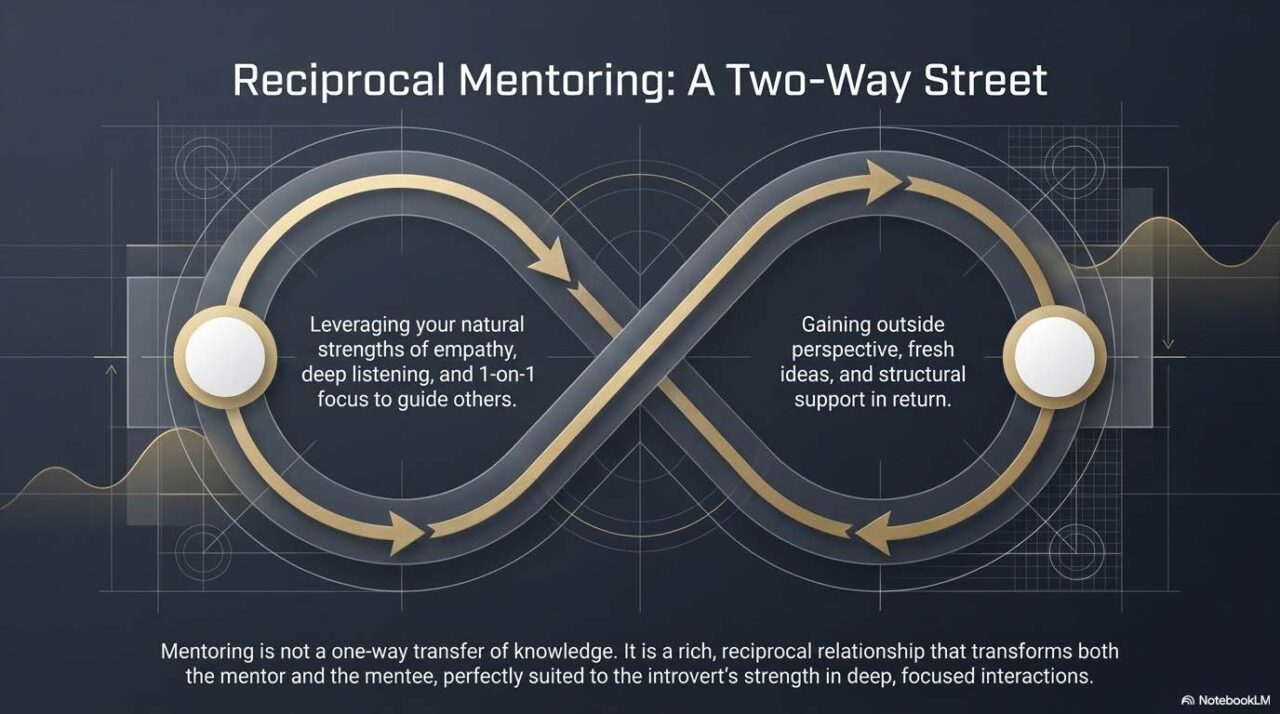
But real mentoring isn’t a one-way download of knowledge. It’s a genuine, two-way relationship that supports both people. And it plays perfectly into our natural strengths because we already thrive in deep, focused, one-on-one conversations.

When you stop treating mentoring like a formal transaction, you can lean into what you already do best:

  • Listen instead of trying to perform: You don’t need a flawless script. Your natural empathy and ability to listen deeply are exactly what will help guide someone else through their challenges.

  • Swap fresh perspectives: It’s a true mutual exchange. You get to step outside your own bubble, grab fresh ideas, and find real structural support in return.

  • Take the pressure off: Because it’s a partnership, you don’t need to be the perfect expert. You’re just two people helping each other navigate the workplace

A slide titled "Reciprocal Mentoring: A Two-Way Street" with a blueprint graphic of a golden triangle overlaid on a circle. It explains that mentoring is a reciprocal, two-way partnership that benefits both the mentor and mentee, perfectly suited to the introvert's natural strength in deep, one-on-one interactions.


Bringing It All Together: The Quiet Ecosystem

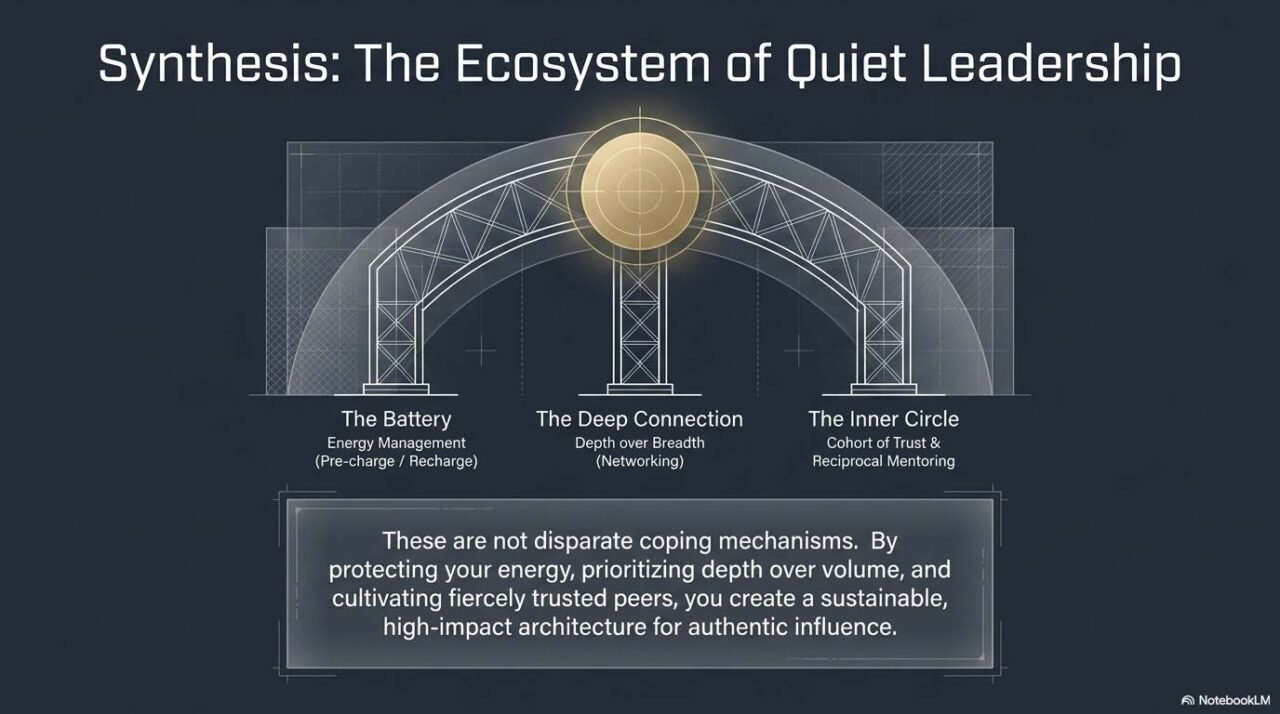
It’s easy to look at a slide deck like this and treat it like a menu of quick tips where you just pick and choose one or two. But these aren’t isolated coping mechanisms—they work together as a complete system.

Think about how they feed into each other:

  • Your Battery: Managing your energy through deliberate quiet time gives you the stamina to show up when it actually matters.

  • Your Focus: Shifting from “working the room” to having one or two deep, meaningful conversations keeps you from draining that battery in the first ten minutes.

  • Your Circle: Having a tiny cohort of trusted peers and reciprocal mentors gives you a safe space to recharge and get reality checks so you can keep going long-term.

When you protect your energy, focus on depth over crowd size, and surround yourself with a small circle of trusted people, you build a sustainable foundation for real influence. You don’t have to change who you are—you just have to work with your natural wiring.

A slide titled "Synthesis: The Ecosystem of Quiet Leadership" displaying a conceptual grid summarizing the three core pillars: "The Battery" (energy management), "The Deep Connection" (depth over breadth in networking), and "The Inner Circle" (cohort of trust and reciprocal mentoring), showing how they work together as a complete leadership system.

Take the Next Step

If you are looking for a structured, supportive space to practice these communication styles alongside a close-knit community of higher education peers, I invite you to join us.

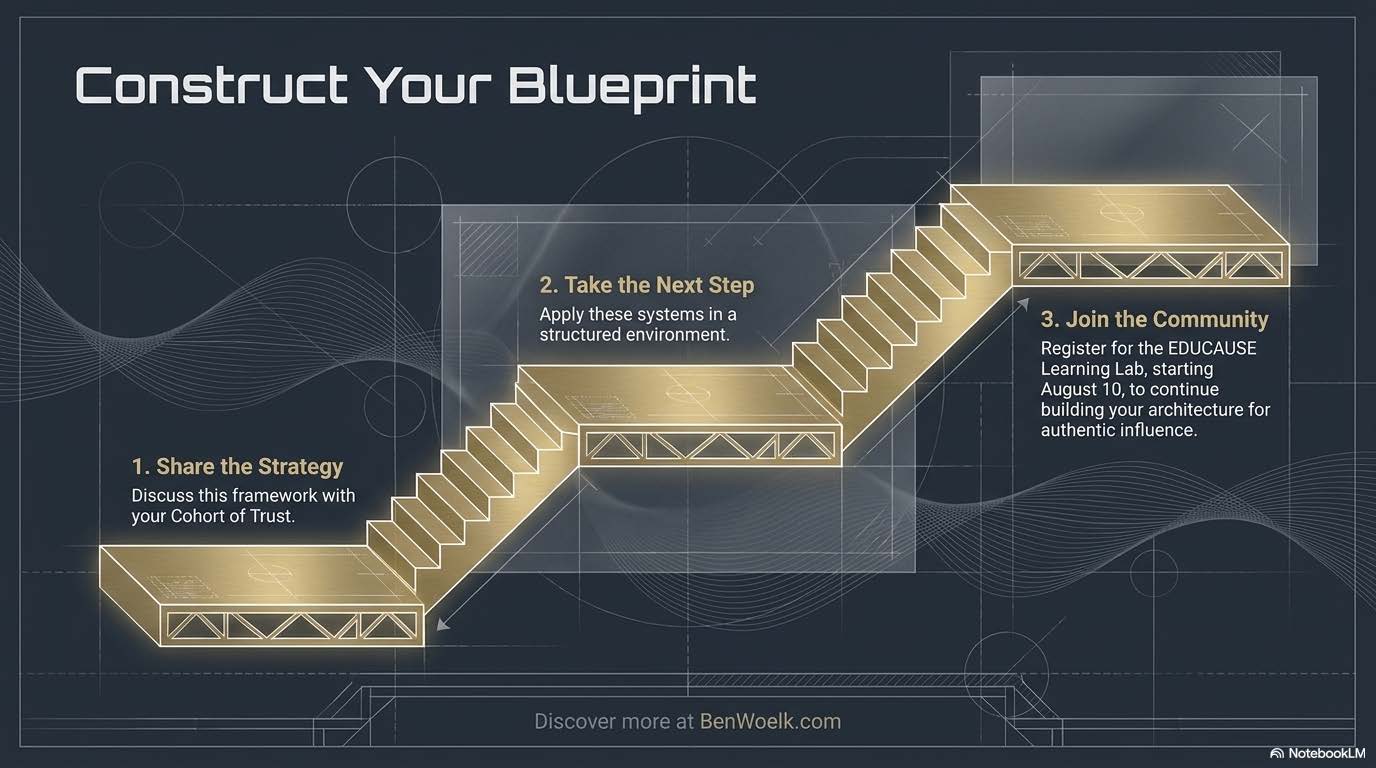
  • 🏫 Join the Community: Register for the upcoming EDUCAUSE Learning Lab, Quiet Leadership: Strategies for Influence and Impact (starting August 10). It’s an online, hands-on space open to both EDUCAUSE members and non-members. [Click here to secure your spot]

  • 🎙️ Listen: Tune in to the full podcast conversation with Andrea Childress on the Hope for the Introvert podcast [Link to Podcast Page].

A slide titled "Construct Your Blueprint" with a blueprint grid background. It lists three call-to-action steps: 1. Share the strategy with your cohort, 2. Apply these systems in a structured environment, and 3. Register for the EDUCAUSE Learning Lab starting August 10. Includes the website URL BenWoelk.com.


Quiet_Leadership_Blueprint PDF

A personal note: This blog post was drawn from prior podcast content, and was assisted with Gemini. The slides were created by NotebookLM.


Subscribe to Blog via Email

Enter your email address to subscribe to this blog and receive notifications of new posts by email.

Join 505 other subscribers

Categories

Support Introverted Leadership on Patreon

Blubrry affiliate banner